

📋 Key Takeaways
- Classical Ayurvedic texts such as the Charaka Samhita and Ashtanga Hridayam describe guda (jaggery) as more than a sweetener—it is traditionally valued as a nourishing food with digestive-supporting properties.
- Ayurveda attributes qualities such as Deepana (supporting digestive fire), Pachana (assisting digestion), Balya (promoting strength), and Brimhana (nourishment) to properly prepared jaggery.
- Traditional Ayurvedic practice recommends different herbal pairings with jaggery depending on an individual’s dosha (Prakriti).
- Unlike refined white sugar, traditionally prepared jaggery retains naturally occurring minerals such as iron, magnesium, calcium, and potassium because it undergoes minimal processing.
- Although nutritionally richer than refined sugar, jaggery is still a source of sugar and is best enjoyed in moderation—typically 10–30 grams daily within a balanced diet.
Introduction
Some memories never leave you.
Mine begins in my grandmother’s kitchen.
Whenever someone arrived at our home—whether it was a neighbour stopping by, a relative visiting unexpectedly, or a tired farmer returning from the fields—she never handed them a glass of water straight away.
Instead, she’d quietly break off a small piece of bella—the Kannada word for jaggery—and place it gently into their palm.
“Eat this first,” she’d say with a smile.
Only then would she pour a brass tumbler full of cool water.
As a child, I assumed it was simply her way of welcoming guests.
Years later, I realized it reflected something much deeper.
It wasn’t merely hospitality.
It was inherited wisdom.
The kind of wisdom that wasn’t learned from books or social media but passed from one generation to the next through everyday rituals in the kitchen.
Across Karnataka—and in many parts of India—jaggery has long held a place that goes far beyond sweetness. It flavours sambar, enriches festive sweets, balances spicy curries, and often marks the beginning of celebrations. Yet in Ayurveda, its importance extends beyond the kitchen.
Classical Ayurvedic literature refers to jaggery as Guda, describing it as a food that, when properly prepared and consumed appropriately, traditionally supports digestion, nourishment, and overall well-being.
Modern nutrition views jaggery differently. Scientists recognize it as an unrefined sweetener that naturally retains minerals removed during the refining of white sugar. While it is not a miracle food—and certainly not a replacement for medical treatment—it offers nutritional characteristics that distinguish it from refined sugar.
This article brings together both perspectives.
We’ll explore:
- What classical Ayurvedic texts say about jaggery.
- How it has traditionally been used for different Ayurvedic constitutions (doshas).
- What modern nutrition tells us about its composition.
- Why many South Indian households continue to treasure it.
- Practical ways to enjoy jaggery safely in everyday life.
My goal isn’t to convince you that jaggery is a cure-all.
Rather, it’s to understand why something as simple as a piece of unrefined sugar has remained a cherished part of Indian kitchens for centuries—and why that old habit of my grandmother’s still makes perfect sense today.
Table of Contents
- 1. What Is Jaggery?
- 2. What Ayurveda Says About Jaggery
- 3. Jaggery’s Nutritional Profile
- 4. How to Use Jaggery According to Your Dosha
- 5. Everyday Uses of Jaggery
- 6. Jaggery Before Water
- 7. Jaggery for Children
- 8. Jaggery vs White Sugar
- 9. How Much Jaggery Should You Eat?
- 10. Choosing Good Jaggery
- 11. Safety & Precautions
- 12. Frequently Asked Questions
- 13. References
- 14. Conclusion
1. What Is Jaggery?
Jaggery is one of humanity’s oldest natural sweeteners.
It is traditionally made by slowly boiling freshly extracted sugarcane juice—or, in some regions, palm sap—until it thickens into a rich golden syrup that eventually cools into solid blocks or cakes.
Unlike refined white sugar, jaggery undergoes very little processing. Because it isn’t stripped of its naturally occurring components during industrial refining, it retains small amounts of minerals naturally present in sugarcane.
This simple production process explains why jaggery has a deep caramel-like flavour, an earthy aroma, and a colour ranging from golden brown to dark amber.
Across India, jaggery is known by many names:
- Guda (Sanskrit)
- Bella (Kannada)
- Gud (Hindi)
- Vellam (Tamil)
- Bellam (Telugu)
Although the names differ, its place in Indian culture remains remarkably consistent.
It sweetens festive dishes, accompanies religious offerings, balances spicy foods, and has long been regarded as an everyday household ingredient rather than an occasional indulgence.
In many South Indian homes—including the one I grew up in—jaggery was never reserved solely for desserts.
A small piece found its way into sambar.
A pinch balanced the bitterness of leafy vegetables.
Freshly prepared laddoos relied on it instead of refined sugar.
Even today, many families instinctively reach for jaggery before they reach for white sugar.
Ayurveda gives us one explanation for this enduring tradition.
2. What Ayurveda Says About Jaggery
For thousands of years, Ayurveda has viewed food as more than fuel.
Every ingredient is understood through its taste (Rasa), qualities (Guna), potency (Virya), post-digestive effect (Vipaka), and its influence on the body’s functional energies, known as the Doshas.
Within this framework, jaggery—referred to as Guda in Sanskrit—is described as a nourishing food with specific traditional properties.
Classical Ayurvedic texts, including the Charaka Samhita and Ashtanga Hridayam, discuss jaggery in the context of wholesome foods and digestive health. While translations and interpretations vary among scholars, several traditional qualities are consistently associated with properly prepared jaggery.
Deepana (Supporting Digestive Fire)
Ayurveda uses the term Deepana to describe substances traditionally believed to kindle Agni, the digestive fire responsible for transforming food into nourishment.
Rather than implying that jaggery “improves digestion” in a modern clinical sense, Ayurveda views it as supporting healthy digestive function within its own medical framework.
Pachana (Assisting Digestion)
Closely related to Deepana is Pachana, referring to supporting the body’s natural digestive processes.
Traditionally, small amounts of jaggery were often consumed after meals rather than before them, reflecting the belief that it complemented digestion.
Brimhana (Nourishment)
Ayurvedic texts describe jaggery as Brimhana, a quality associated with nourishment and supporting healthy body tissues (Dhatus).
This may help explain why jaggery has historically been included in postpartum diets, festival foods, and preparations intended to restore strength after physical labour.
Balya (Supporting Strength)
The term Balya refers to promoting strength and vitality.
Traditionally, jaggery was frequently combined with sesame seeds, peanuts, or ghee—ingredients also valued in Ayurveda—to prepare nourishing foods during colder months and periods of increased physical activity.
Lekhana (A Traditional Ayurvedic Concept)
One of the more intriguing qualities attributed to jaggery is Lekhana.
In Ayurveda, this term is often translated as “scraping” or “cleansing.”
Importantly, this should not be confused with modern concepts such as “detoxification.”
Instead, Lekhana describes an Ayurvedic understanding of maintaining balance within the body’s channels (Srotas) according to classical theory.
A Food That Fits the Individual
Perhaps one of Ayurveda’s most fascinating ideas is that the same food may be used differently depending on the individual.
Rather than viewing foods as universally good or bad, Ayurveda considers a person’s constitution (Prakriti), digestive capacity (Agni), season, age, and overall health.
For this reason, jaggery is often paired with different herbs depending on whether a person predominantly exhibits Vata, Pitta, or Kapha characteristics.
We’ll explore these traditional combinations in the next section.
Editorial Note
The Ayurvedic properties described above are based on classical Ayurvedic literature and traditional practice. They represent concepts within Ayurveda and should not be interpreted as established clinical evidence or medical claims. Individual health concerns should always be discussed with a qualified healthcare professional.
3. Jaggery’s Nutritional Profile: What Modern Science Adds
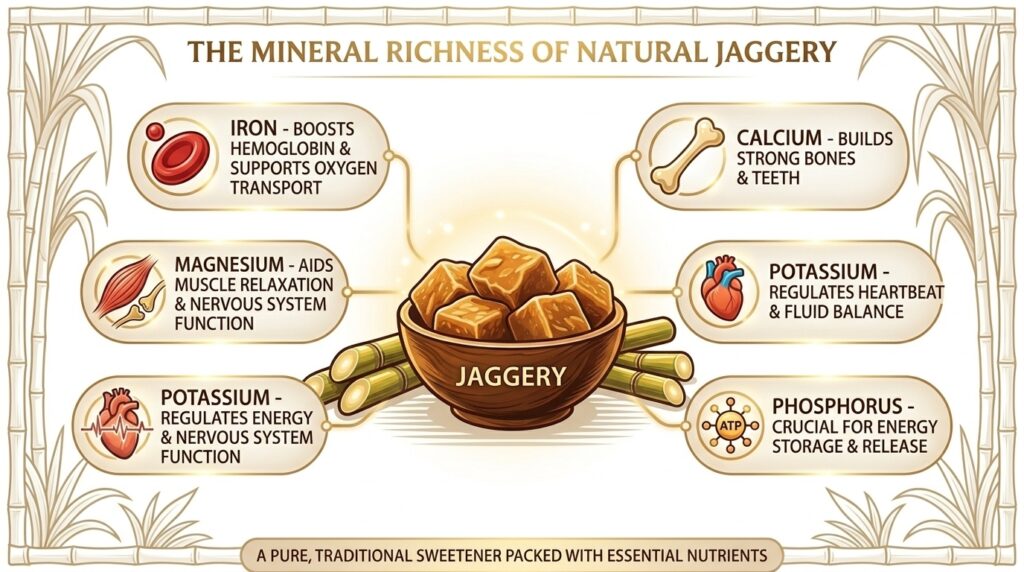
For centuries, Ayurveda described jaggery as a nourishing food. Today, modern nutrition helps explain one reason why.
Unlike refined white sugar, traditionally prepared jaggery undergoes minimal processing. Fresh sugarcane juice is slowly heated until it thickens and solidifies, preserving a portion of the minerals naturally present in the cane.
Although jaggery is still predominantly composed of carbohydrates, it also contains small amounts of minerals such as:
- Iron – contributes to the normal formation of red blood cells and haemoglobin.
- Magnesium – supports normal muscle and nerve function.
- Calcium – contributes to healthy bones and teeth.
- Potassium – helps maintain normal muscle function and fluid balance.
- Phosphorus – supports energy metabolism and bone health.
The exact nutrient content varies depending on the variety of sugarcane, soil quality, harvesting methods, and traditional preparation techniques. For this reason, no two batches of jaggery are nutritionally identical.
Why Is It Different from White Sugar?
When sugarcane is refined into white sugar, several stages of industrial processing remove impurities, molasses, and naturally occurring minerals. The final product is almost entirely sucrose.
Jaggery, on the other hand, retains much of its natural molasses, giving it its characteristic colour, flavour, and mineral content.
That doesn’t mean jaggery is a miracle food.
Its value lies in what remains after minimal processing—not because it contains extraordinary amounts of nutrients, but because it retains compounds that refined sugar largely loses.
Is Jaggery Healthier Than Sugar?
This is probably the question people ask most often.
The honest answer is:
It depends on what you mean by “healthier.”
If you’re comparing vitamin and mineral content, jaggery has an advantage because it naturally contains small amounts of nutrients absent from refined sugar.
However, if you’re looking at calories or total sugar content, the difference is much smaller.
Both jaggery and white sugar should be consumed thoughtfully as part of a balanced diet.
Choosing jaggery over refined sugar doesn’t give us permission to consume unlimited sweets.
Instead, Ayurveda teaches moderation—a principle that modern nutrition continues to support.
A Meeting Point Between Tradition and Science
Perhaps the most interesting takeaway is that Ayurveda and modern nutrition arrive at similar observations from different directions.
Ayurveda evaluated jaggery through qualities such as Brimhana (nourishment) and Balya (supporting strength).
Modern nutrition evaluates it through naturally occurring carbohydrates and retained minerals.
Different languages.
Different systems.
Yet both recognize that minimally processed foods often preserve more of their original nutritional character.
4. How to Use Jaggery According to Your Dosha
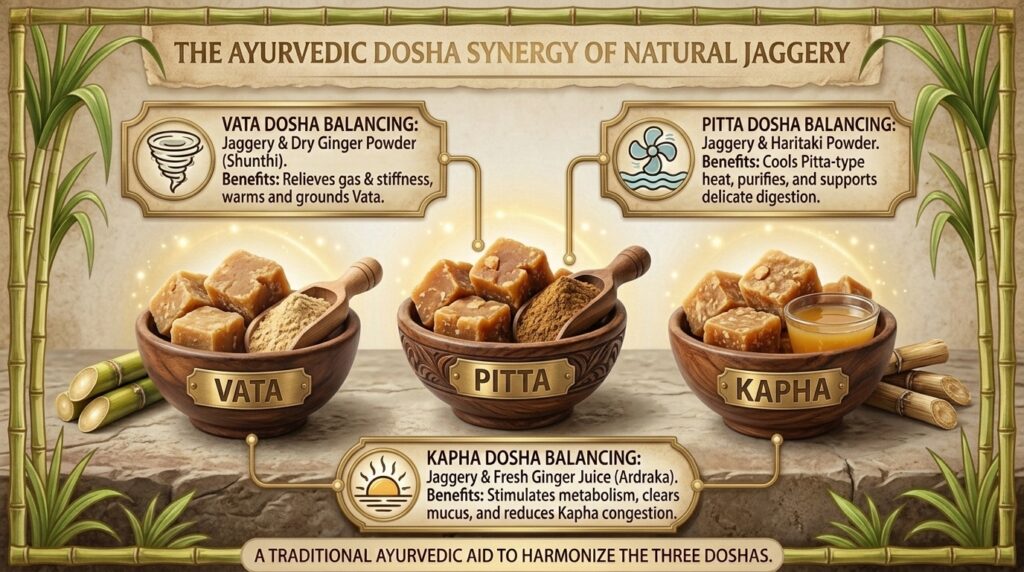
One of Ayurveda’s defining principles is that there is no universally perfect food.
The same ingredient may affect different people differently depending on their Prakriti (constitution), digestive capacity (Agni), age, season, and overall state of health.
Rather than asking,
“Is jaggery good or bad?”
Ayurveda asks,
“For whom, in what quantity, during which season, and in what combination?”
This personalized approach is one of the reasons Ayurveda continues to fascinate people today.
If you don’t know your constitutional type, don’t worry.
A qualified Ayurvedic practitioner can determine your Prakriti through a comprehensive assessment, traditionally including Nadi Pariksha (pulse examination), observation, and discussion of your health history.
Until then, enjoying plain jaggery in moderation is perfectly reasonable for most healthy individuals.
Let’s explore the traditional pairings.
For Vata Constitution
Vata is associated with qualities such as dryness, lightness, movement, and coldness.
When Vata becomes aggravated, Ayurveda traditionally associates it with irregular digestion, dryness, stiffness, and fluctuating energy.
Because jaggery possesses warming and nourishing qualities, Ayurveda often pairs it with another warming herb:
Traditional Combination
- 1 teaspoon powdered jaggery
- ¼ teaspoon dry ginger powder (Shunthi Churna)
Traditionally, this combination is consumed after meals.
Ayurvedic practitioners have long used this pairing to support healthy digestion and help balance Vata’s naturally cold and dry qualities.
🌿 AyurLoom Tip
This combination is traditionally preferred during cooler weather, when Vata qualities naturally become more prominent.
For Pitta Constitution
Pitta represents transformation, metabolism, and heat.
People with dominant Pitta constitutions often tolerate digestion well, but Ayurveda suggests that excessive Pitta may manifest as excess internal heat or acidity.
Although jaggery possesses warming potency (Ushna Virya), its naturally sweet taste (Madhura Rasa) is traditionally considered balancing when used appropriately.
Traditional Combination
- 1 teaspoon jaggery
- A small pinch of Haritaki (Terminalia chebula) powder
This traditional pairing is typically taken alongside meals rather than on an empty stomach.
Because both ingredients possess significant Ayurvedic actions, moderation is emphasized.
🌿 AyurLoom Tip
Individuals with pronounced Pitta constitutions should consult an experienced Ayurvedic practitioner before using herbal combinations regularly, especially during hot summer months.
For Kapha Constitution
Kapha embodies stability, structure, heaviness, and moisture.
When Kapha becomes excessive, Ayurveda traditionally associates it with sluggish digestion, feelings of heaviness, and congestion.
To complement these qualities, Ayurveda pairs jaggery with fresh ginger.
Traditional Combination
- 1 teaspoon jaggery
- 1 teaspoon freshly extracted ginger juice
Fresh ginger is widely respected in Ayurveda for its warming and stimulating qualities.
Together, this traditional combination has long been used to encourage digestive comfort and support balanced Kapha.
🌿 AyurLoom Tip
Many Ayurvedic households prepare fresh ginger juice immediately before use, believing freshly extracted juice retains its desirable qualities better than stored preparations.
Ayurveda Looks Beyond Ingredients
One of the most beautiful lessons Ayurveda teaches is that healing rarely depends on a single ingredient.
Context matters.
The season matters.
The quantity matters.
Your digestion matters.
Even your emotional state matters.
Jaggery isn’t viewed as universally beneficial simply because it’s natural.
Instead, Ayurveda encourages mindful use—choosing the right food, in the right amount, at the right time, for the right individual.
Perhaps that’s why traditional kitchens rarely treated food as something separate from health.
Every meal was an opportunity to nourish the body with intention.
5. Everyday Uses of Jaggery in Traditional Kitchens
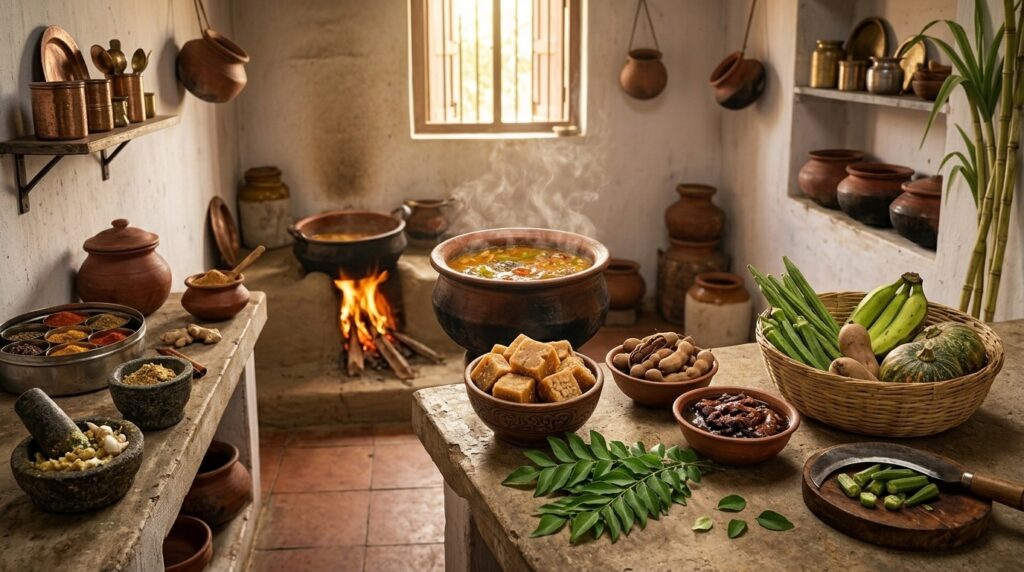
Long before jaggery appeared in health food stores or wellness blogs, it quietly occupied a permanent place in Indian kitchens.
Growing up, I never questioned why my grandmother reached for jaggery while making sambar.
It simply belonged there.
Only later did I understand that she wasn’t adding sweetness.
She was creating balance.
Every pot of sambar began with three familiar companions:
- Tamarind
- Asafoetida (Hing/Ingu)
- Jaggery
Each contributed something different.
The tamarind added brightness.
The asafoetida brought depth and was traditionally valued in Ayurveda for supporting comfortable digestion.
The small piece of jaggery softened sharp acidity, rounded the flavours, and completed the dish without making it noticeably sweet.
That tiny addition was almost invisible.
Yet if she forgot it—which rarely happened—the entire dish somehow felt incomplete.
This philosophy extended beyond sambar.
Across generations, jaggery found its way into countless traditional recipes.
Some of the most cherished include:
- Til (sesame) laddoos, especially during winter festivals.
- Peanut laddoos, prepared as naturally sweet energy snacks.
- Vegetable palya, where a small amount balances bitterness.
- Traditional chutneys, enhancing both flavour and complexity.
- Herbal preparations, where jaggery often acts as a natural carrier alongside selected Ayurvedic herbs.
In Ayurveda, cooking has never been only about satisfying hunger.
It is about creating harmony—between tastes, digestion, seasons, and the individual eating the meal.
Sometimes that harmony begins with nothing more than a small piece of jaggery.
6. Jaggery Before Water: An Old Tradition Worth Understanding
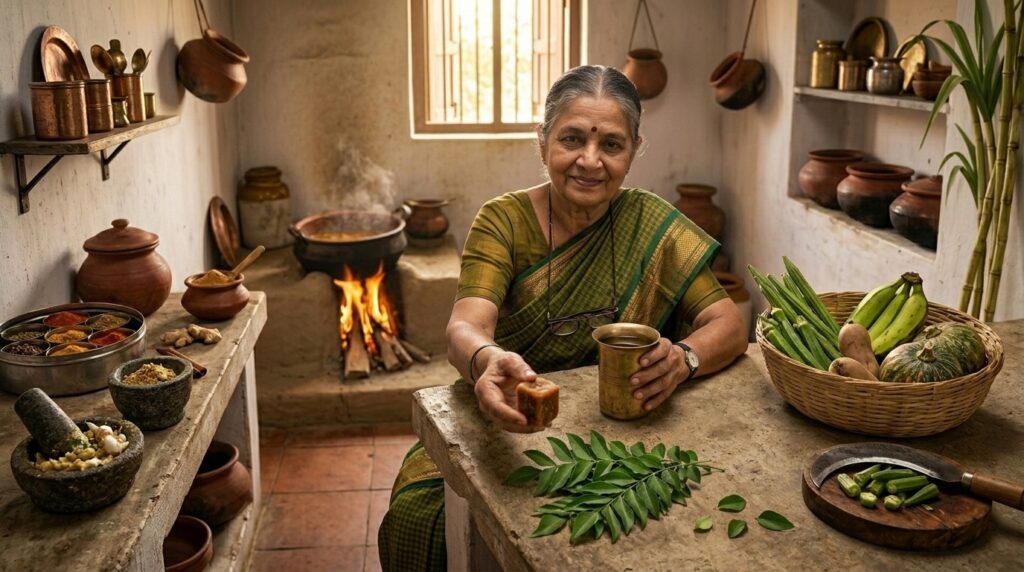
Some traditions survive for centuries because they become habits.
Others survive because they quietly work.
One of the customs I remember most vividly from my childhood was my grandmother’s insistence that no one should drink water immediately after entering the house.
Whether it was a family member returning from work, a neighbour dropping in, or a traveller seeking a drink, she always followed the same routine.
First came a small piece of jaggery.
Then came a brass tumbler filled with cool water.
As children, we accepted it without asking why.
Years later, curiosity led me to explore the reasoning behind this simple ritual.
More Than a Sweet Welcome
Across many parts of Karnataka and other regions of India, offering jaggery and water has long symbolized warmth, generosity, and good wishes.
Food has always been central to Indian hospitality, and jaggery—with its pleasant sweetness and cultural significance—naturally became part of welcoming guests.
But Ayurveda often sees another layer beneath everyday customs.
Traditional Ayurvedic thinking places great importance on Agni, the digestive fire believed to govern how food and drink are processed within the body.
Rather than consuming large amounts of water immediately, offering a small piece of jaggery first was traditionally considered a gentle way to prepare the body before drinking.
While classical texts describe this through Ayurvedic principles rather than modern physiology, the practice reflects a broader philosophy: eat and drink with awareness, not haste.
What Does Modern Nutrition Say?
From a modern nutritional perspective, jaggery naturally contains small amounts of minerals such as potassium, calcium, and magnesium that are largely absent from refined sugar.
These minerals contribute to normal physiological functions within the body.
However, it’s important to keep their quantity in perspective.
The amount of minerals found in a small serving of jaggery is modest and should not be viewed as a substitute for balanced nutrition, oral rehydration solutions, or electrolyte beverages when medical rehydration is needed.
Instead, this traditional practice can be appreciated as a thoughtful cultural habit—one that paired a minimally processed food with simple hospitality.
A Lesson Beyond Nutrition
Perhaps the greatest value of this tradition isn’t nutritional at all.
It teaches mindfulness.
Today, many of us gulp down water while walking, scrolling through our phones, or rushing between meetings.
Traditional households often approached eating and drinking differently.
People sat down.
They paused.
They acknowledged the guest.
They shared something sweet.
Only then did the meal—or even a glass of water—begin.
Whether viewed through the lens of Ayurveda or simply as a beautiful cultural practice, that small pause reminds us that nourishment isn’t only about what we consume.
Sometimes it’s about how we receive it.
7. Jaggery for Children: A Traditional Alternative to Refined Sweets

Ask almost any parent today about nutrition, and one concern appears again and again:
Too much sugar.
Brightly coloured candies, packaged desserts, sugary breakfast cereals, and sweetened drinks have become everyday foods for many children.
Traditional Indian kitchens approached sweetness differently.
Children certainly enjoyed sweet foods—but those sweets were often prepared at home using ingredients like jaggery, sesame seeds, peanuts, coconut, roasted gram, and ghee.
The sweetness came packaged with wholesome ingredients rather than highly processed additives.
Why Families Traditionally Preferred Jaggery
For generations, jaggery has been used in homemade snacks across India, not because it was considered a miracle ingredient, but because it was the natural sweetener readily available before refined sugar became widespread.
Some traditional favourites include:
- Sesame and jaggery laddoos (Ellu Unde / Til Ladoo) – especially popular during winter festivals.
- Peanut and jaggery chikki – a crunchy snack combining natural sweetness with plant-based protein.
- Jaggery spread with ghee on warm chapati – a comforting meal many Indian children grew up enjoying.
- Puffed rice mixed with jaggery syrup – a festive treat that remains popular across many regions.
These foods provided sweetness while also incorporating grains, seeds, or nuts—ingredients valued in both traditional cooking and modern nutrition.
The Ayurvedic Perspective
Ayurveda traditionally associates properly prepared jaggery with qualities such as Brimhana (nourishment) and Balya (supporting strength).
Some classical Ayurvedic texts also describe jaggery as Medhya, a term traditionally associated with supporting mental clarity.
These descriptions belong to the Ayurvedic system of medicine and should not be interpreted as direct clinical claims.
A Practical Perspective for Today’s Parents
Choosing homemade sweets over highly processed packaged snacks can be a meaningful step toward healthier eating habits.
That said, moderation remains essential.
Jaggery is still a source of sugar.
Whether the sweetener is jaggery, honey, maple syrup, or refined sugar, excessive intake is not recommended.
For children over one year of age, small portions of homemade jaggery-based treats can be part of a balanced diet when enjoyed alongside plenty of fruits, vegetables, whole grains, and regular physical activity.
🌿 AyurLoom Tip
Avoid giving jaggery—or any added sweetener—to infants under 12 months of age. As children grow older, focus on offering naturally sweet foods as occasional treats rather than everyday habits.
8. Jaggery vs. White Sugar: Is One Better Than the Other?
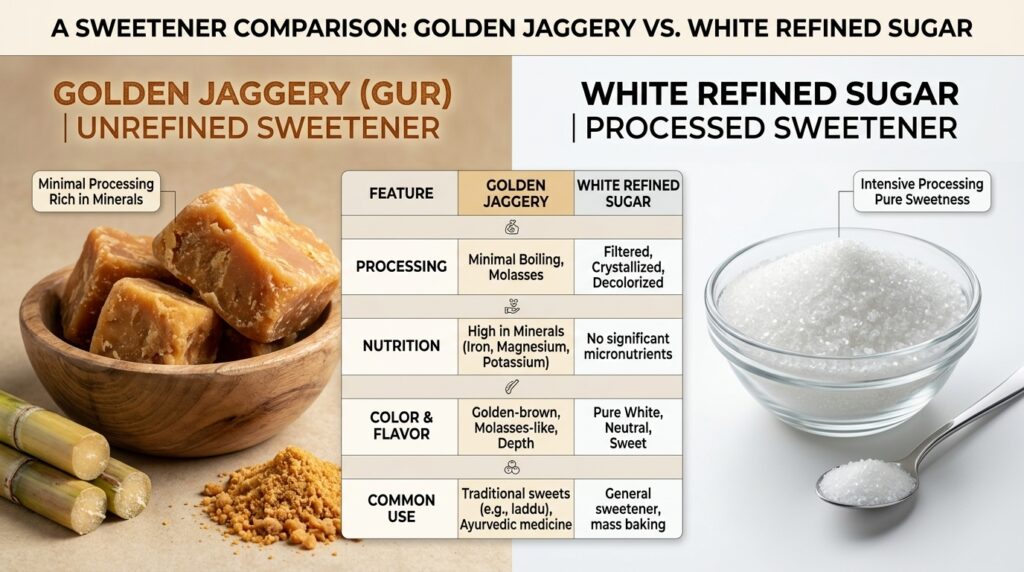
Few foods spark as much debate as jaggery.
Some people describe it as a superfood.
Others argue it’s no different from sugar.
As is often the case, the truth lies somewhere in between.
Both jaggery and white sugar originate from sugarcane.
The difference lies not in the plant—but in what happens after harvest.
How White Sugar Is Made
To produce refined white sugar, sugarcane juice undergoes multiple stages of clarification, filtration, crystallization, and refining.
The goal is consistency: a product that is nearly pure sucrose, with a bright white appearance, neutral flavour, and long shelf life.
During this process, most naturally occurring minerals and molasses are removed.
How Traditional Jaggery Is Made
Traditional jaggery follows a much simpler path.
Fresh sugarcane juice is slowly boiled until it thickens.
It is then poured into moulds and allowed to cool naturally.
Because it undergoes far less processing, jaggery retains its characteristic caramel flavour, deep golden colour, and naturally occurring mineral content.
A Practical Comparison
| Feature | Traditional Jaggery | Refined White Sugar |
|---|---|---|
| Processing | Minimal | Highly refined |
| Mineral Content | Naturally retains small amounts | Negligible |
| Flavour | Rich, earthy, caramel-like | Neutral sweetness |
| Colour | Golden to dark brown | Bright white |
| Traditional Ayurvedic Use | Yes | Not described in classical Ayurveda |
So, Which Should You Choose?
If your goal is simply to satisfy a sweet craving, both contribute sugar to the diet.
If you’re choosing between the two, traditionally prepared jaggery offers the advantage of minimal processing and naturally retained minerals.
That doesn’t mean it’s a “free food.”
The healthiest approach isn’t replacing unlimited sugar with unlimited jaggery.
It’s reducing overall added sugar while choosing minimally processed options whenever practical.
Perhaps that’s the greatest lesson Ayurveda offers here.
Health isn’t usually created by one extraordinary ingredient.
It’s built through countless small, mindful choices repeated every day.
9. How Much Jaggery Should You Eat?
When people discover that jaggery contains naturally occurring minerals, the next question is almost always:
“If it’s healthier than sugar, can I eat as much as I want?”
The answer is no.
One of Ayurveda’s central teachings is moderation. Even foods regarded as nourishing should be consumed in quantities appropriate for the individual, the season, and the body’s needs.
Traditionally, jaggery is enjoyed as a complement to meals—not as a food to consume freely throughout the day.
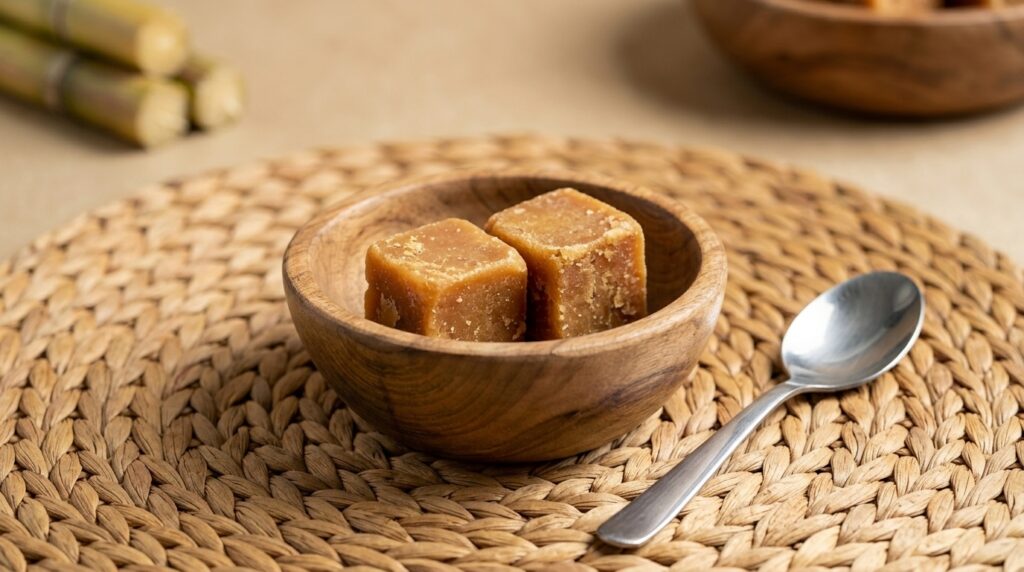
For most healthy adults, 10 to 30 grams per day (roughly one to two small pieces) is generally considered a moderate amount within a balanced diet.
That quantity allows you to enjoy its flavour and traditional role without contributing excessive added sugars.
Why Moderation Matters
Although jaggery retains naturally occurring minerals, it is still primarily composed of carbohydrates, including sucrose, glucose, and fructose.
Eating excessive amounts may contribute to:
- Increased calorie intake
- Elevated blood sugar levels
- Weight gain when consumed regularly in excess
- Reduced appetite for more nutrient-dense foods
Ayurveda itself discourages excess.
In fact, one of its enduring principles is that the right food, consumed in the wrong quantity, may no longer be beneficial.
Practical Ways to Enjoy Jaggery
Instead of thinking of jaggery as a dessert, consider using it intentionally:
- Replace refined sugar in your morning chai.
- Add a small piece to homemade sambar.
- Enjoy a sesame-jaggery laddoo after a meal.
- Sweeten herbal drinks occasionally.
- Pair it with roasted peanuts or sesame during winter.
Small habits practiced consistently often have a greater impact than dramatic dietary changes.
10. How to Choose Good Quality Jaggery
Not all jaggery is created equal.
As demand has grown, so has the variety available in markets. Some products are prepared using traditional methods, while others may involve processing techniques intended to improve colour, texture, or shelf life.
Learning how to recognize good-quality jaggery helps you make a more informed choice.
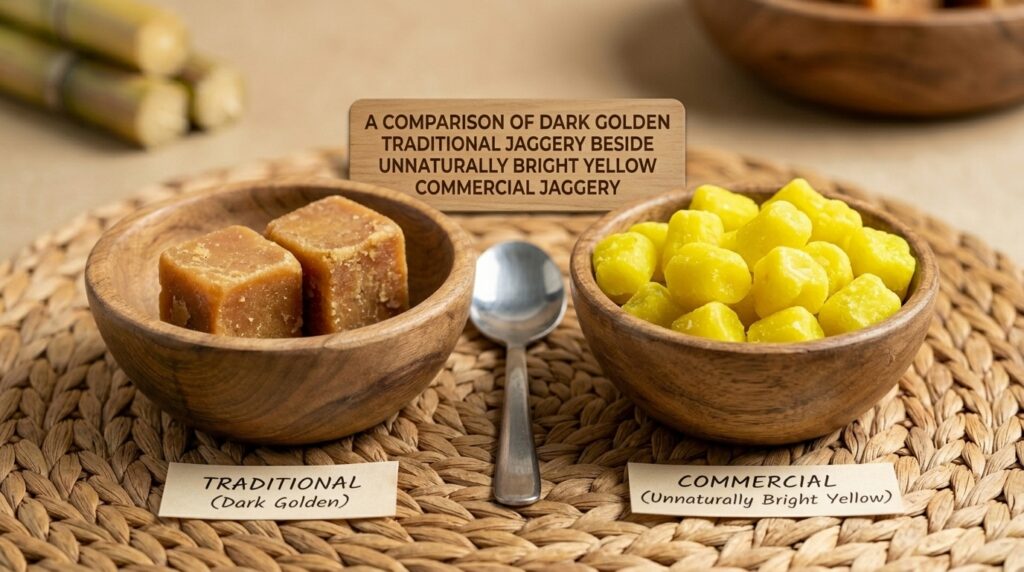
Look for Natural Colour
Traditionally prepared jaggery usually ranges from golden brown to deep brown.
An unusually bright yellow or very pale appearance may indicate additional processing or clarifying agents.
Colour alone doesn’t determine quality, but it offers a useful starting point.
Notice the Aroma
Fresh, high-quality jaggery has a pleasant aroma reminiscent of sugarcane, caramel, and molasses.
A sour, chemical, or overly artificial smell may suggest poor storage or processing.
Feel the Texture
Traditional jaggery is usually firm yet easy to break.
It may feel slightly grainy because it hasn’t been heavily refined.
Extremely smooth or waxy textures can sometimes indicate additional processing.
Read the Label
When buying packaged jaggery, choose products with:
- Minimal ingredients
- No artificial colours
- No added preservatives where possible
- Transparent sourcing information
- Organic certification if that aligns with your preferences
Buying directly from trusted farmers or reputable traditional producers is often the best way to understand how the jaggery was made.
🌿 From the AyurLoom Kitchen
My grandmother never chose the lightest-looking jaggery.
She would pick up two blocks, break off a tiny corner, smell them carefully, and choose the one that carried the richest sugarcane aroma.
“Good jaggery should smell alive,” she’d say.
At the time, I thought she was simply being particular.
Today, I realize she was relying on years of experience rather than marketing labels.
11. Things to Keep in Mind
Traditional foods deserve the same thoughtful consideration as modern ones.
Although jaggery has been enjoyed for centuries, there are situations where moderation—and sometimes professional guidance—is especially important.
If You Have Diabetes or Prediabetes
Jaggery may contain more minerals than refined sugar, but it still raises blood glucose.
Replacing white sugar with jaggery does not make a food sugar-free or suitable for unrestricted consumption.
If you are managing diabetes or prediabetes, speak with your doctor or a registered dietitian before making significant dietary changes.
During Pregnancy
In many parts of India, small amounts of jaggery are traditionally included in pregnancy and postpartum meals.
However, every pregnancy is different.
If you have gestational diabetes or any pregnancy-related complications, seek guidance from your healthcare provider before increasing your intake.
If You’re Using Ayurvedic Herbs
Traditional combinations involving herbs such as Haritaki or Ashwagandha should ideally be used under the guidance of a qualified Ayurvedic practitioner.
Natural does not always mean appropriate for everyone.
For Children
Homemade jaggery-based treats can be part of a balanced diet for older children.
However, avoid giving jaggery—or any added sweetener—to infants under one year of age.
Remember the Bigger Picture
No single food determines health.
A balanced diet, regular physical activity, adequate sleep, stress management, and mindful eating all work together.
Jaggery is one small piece of that larger picture.
12. Frequently Asked Questions
Can I replace all white sugar with jaggery?
In many traditional recipes, yes.
Jaggery works beautifully in tea, desserts, laddoos, chutneys, and even savoury dishes like sambar.
Keep in mind that its richer flavour may slightly alter the taste of recipes.
Is jaggery good for weight loss?
Not directly.
Jaggery contains calories similar to refined sugar.
Its advantage lies in minimal processing and naturally retained minerals—not in reduced calorie content.
If you’re trying to lose weight, moderation remains essential.
Can people with diabetes eat jaggery?
Jaggery still affects blood sugar levels.
People with diabetes should not assume it is a safe substitute for sugar without discussing it with their healthcare provider.
What is the best time to eat jaggery?
Traditionally, many households enjoy small amounts after meals or incorporate it into cooking.
Ayurveda individualizes recommendations according to constitution, digestive capacity, and season.
Is jaggery better than brown sugar?
They are different products.
Brown sugar is usually refined white sugar with molasses added back.
Traditional jaggery is produced by concentrating sugarcane juice with minimal refining.
How long does jaggery last?
When stored in an airtight container away from moisture, jaggery generally keeps well for several months.
Proper storage helps preserve both flavour and texture.
References
Classical Ayurvedic Texts
- Charaka Samhita
- Ashtanga Hridayam
- Sushruta Samhita (where relevant)
Modern Nutrition Resources
- Indian Food Composition Tables (ICMR–National Institute of Nutrition)
- USDA FoodData Central
- World Health Organization guidance on free sugar intake
Conclusion
When I think about jaggery today, I don’t think first about nutrition labels or mineral charts.
I think about my grandmother.
I think about the quiet confidence with which she cooked.
She never described jaggery as a superfood.
She never spoke about antioxidants or wellness trends.
She simply trusted what generations before her had practiced.
A small piece in the sambar.
A handful folded into sesame laddoos during winter.
A sweet welcome offered before a glass of water.
Looking back, I realize those weren’t random habits.
They reflected a way of living that valued balance over excess, tradition alongside observation, and food as an everyday expression of care.
Modern nutrition doesn’t replace that wisdom.
Nor does Ayurveda replace science.
Instead, the two can complement one another.
Science helps us understand the nutrients found in foods like jaggery.
Ayurveda reminds us to consider something equally important: how, when, and why we eat.
If there’s one lesson worth carrying into today’s kitchens, perhaps it’s this:
Health rarely comes from dramatic changes.
It grows from small, thoughtful choices repeated day after day.
Maybe that begins by replacing refined sugar with a small piece of traditional jaggery.
Or maybe it begins, as it did in my grandmother’s home, by offering someone something sweet before a simple glass of water.
Sometimes, the oldest traditions still have something meaningful to teach us.
Author’s Note
This article explores jaggery through the perspectives of both traditional Ayurveda and modern nutrition. Ayurvedic concepts reflect a classical system of medicine with its own terminology and principles and should not be interpreted as direct medical claims. The nutritional information presented here is intended for educational purposes and should not replace personalized advice from qualified healthcare professionals.