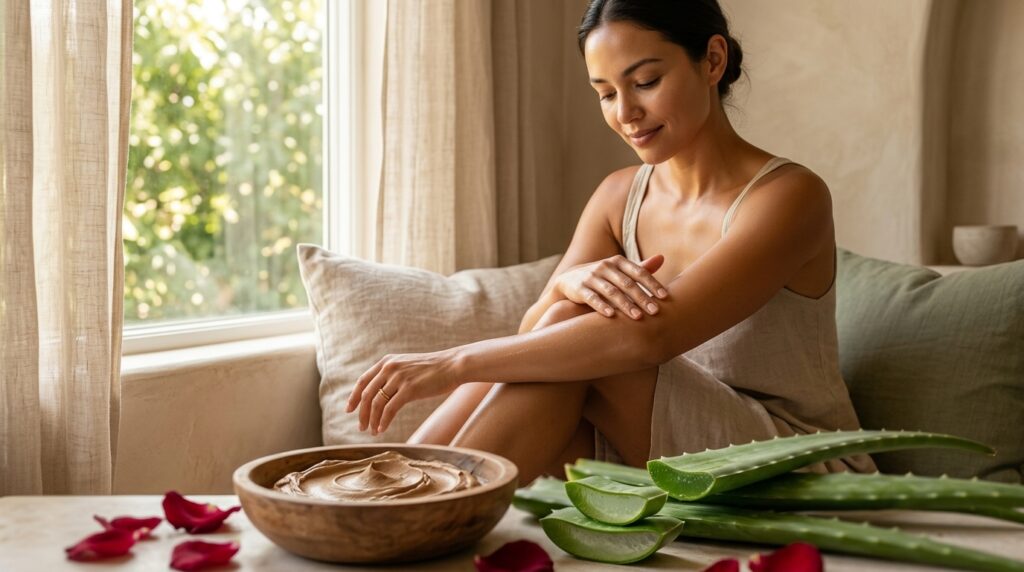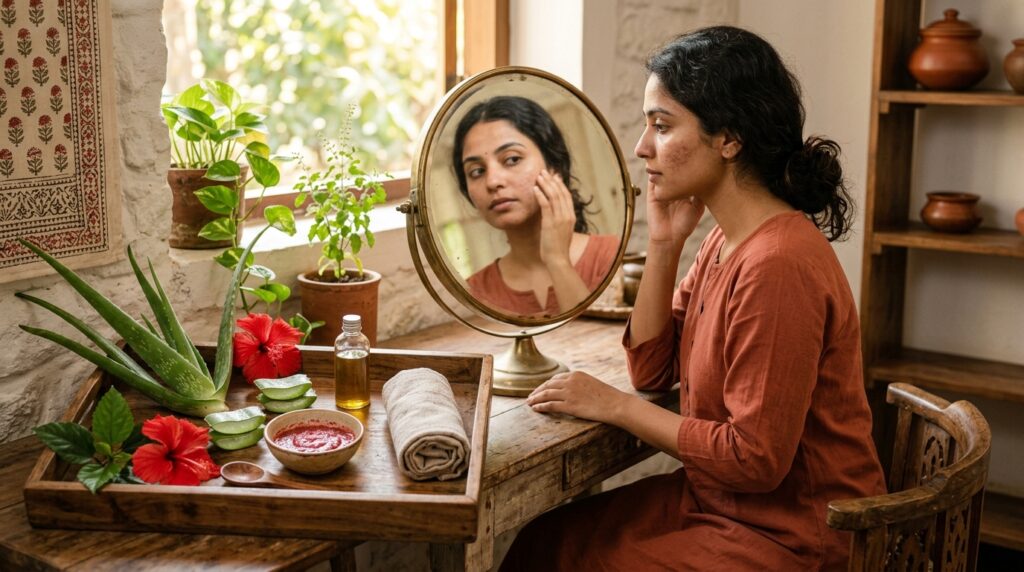

If your skin gets itchy, dry, or sensitive the moment summer arrives, Ayurvedic tradition points to excess Pitta — the body’s internal heat energy — as a likely contributing factor. A traditional 21-day routine combining a Triphala herbal decoction, a cooling oil massage, and a herbal bath powder in place of soap has been passed down in South Indian households to support skin comfort through the hot months. This is a traditional practice shared for educational purposes only, not a clinical treatment, and persistent or severe skin symptoms should always be evaluated by a dermatologist. Now let us know the traditional way we followed for the itchy skin in summer…
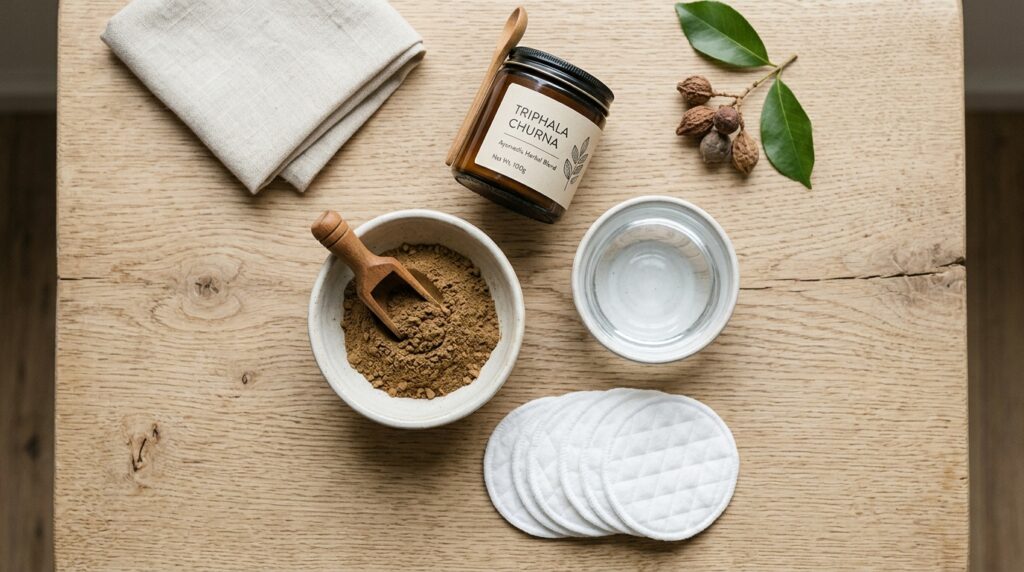
Table of Contents
- Why Summer Makes Skin Feel Worse
- The 21-Day Ritual My Grandmother Followed
- Why Soap Is Avoided in This Tradition
- How to Use This Routine
- Things to Keep in Mind
- When to See a Dermatologist
- Frequently Asked Questions
Why Summer Makes Skin Feel Worse
My grandmother had a saying for the first hot week of summer every year: “the skin starts complaining before the body does.”
She was right more often than not. Every April, without fail, someone in our house in Karnataka would start scratching at a forearm, or complain that their skin felt tight and papery no matter how much they moisturized. We called it heat-related skin irritation — that prickly, itchy sensitivity that shows up on hot, humid days.
If you are reading this in the middle of a brutal American summer with skin that itches, feels unusually dry, or seems more reactive than usual, you are dealing with something people in hot climates have been managing for a very long time.

This article walks through what Ayurvedic tradition says about seasonal skin sensitivity, and a specific 21-day routine that has been passed down in South Indian households for supporting skin comfort.
What Is Pitta, and Why Does It Matter in Summer?
In Ayurveda — the traditional system of wellness that originated in India thousands of years ago — the body is understood through three energies called doshas: Vata (movement and air), Pitta (heat and transformation), and Kapha (structure and stability). Everyone has all three, but in different proportions, and they are believed to shift with the seasons.
Pitta is associated with heat, metabolism, and intensity. Summer is considered “Pitta season” in Ayurvedic tradition, because the external heat is thought to add to the body’s internal heat. According to Ayurvedic tradition, excess Pitta is believed to manifest through symptoms such as redness, itching, dryness, and skin sensitivity — particularly during the hottest months.
This transcript also references something called Tridosha vyatyasa — an imbalance across all three doshas, not just Pitta alone. In plain terms: when seasonal skin sensitivity is stubborn or recurring, Ayurvedic tradition suggests the root cause may not be a single factor, but a broader imbalance that benefits from a more complete approach — which is what the 21-day routine below is built around.

The 21-Day Ritual My Grandmother Followed
This routine comes directly from traditional South Indian Ayurvedic teaching, and is built around the idea that seasonal skin discomfort responds to consistency more than intensity. It is not a single application — it is a daily ritual, repeated for 21 days.
Step 1: Triphala Kashaya (Herbal Decoction)
Triphala is a well-known combination of three dried fruits — Amla (Indian gooseberry), Bibhitaki, and Haritaki — that has been used in Ayurvedic households for generations, usually as a powder.
To prepare the kashaya:
- Take 1 teaspoon of Triphala powder (choorna)
- Boil it in 1 cup of water
- Let it reduce down to about half a cup
- Strain it through a clean cotton cloth or fine strainer
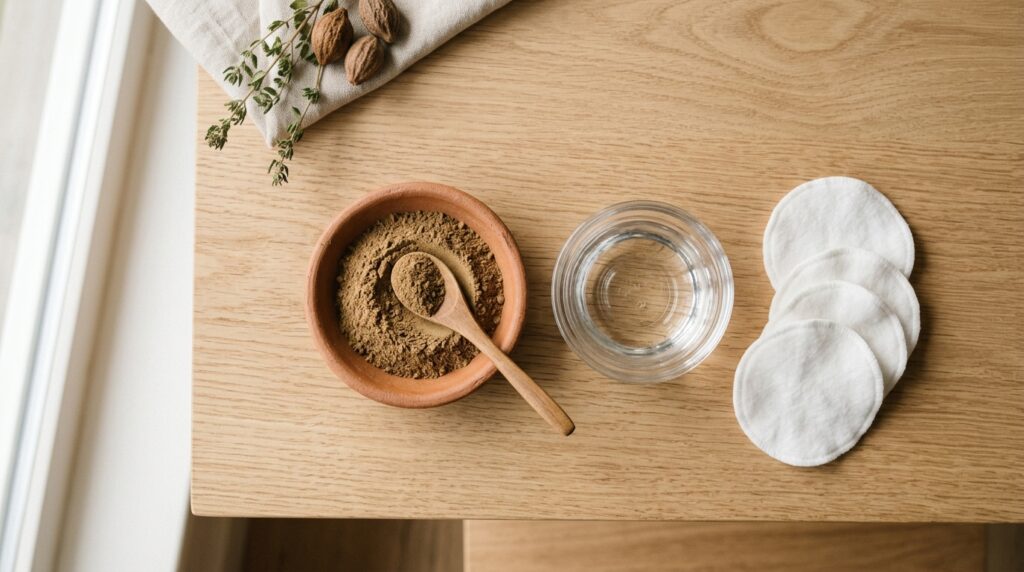
This cooled, strained liquid is then applied gently all over the skin using a piece of cotton — not poured directly, but dabbed and smoothed on like a toner.
Step 2: Jatyadi Oil Massage
Once the Triphala kashaya has fully dried on the skin, the next step is a gentle massage with Jatyadi oil — an oil formulation that has traditionally been used in Ayurvedic texts for external skin application.
The oil is massaged in and then left on the skin for about one hour, undisturbed.
These practices represent traditional South Indian Ayurvedic household knowledge and are shared for educational purposes only. They are not intended to diagnose, treat, cure, or prevent disease. Individual responses vary, and persistent symptoms should always be evaluated by a qualified healthcare professional.
Why Soap Is Avoided in This Tradition
After the oil has had time to sit, it’s time to rinse — but tradition is specific here: cool or lukewarm water only, and no soap or shampoo.
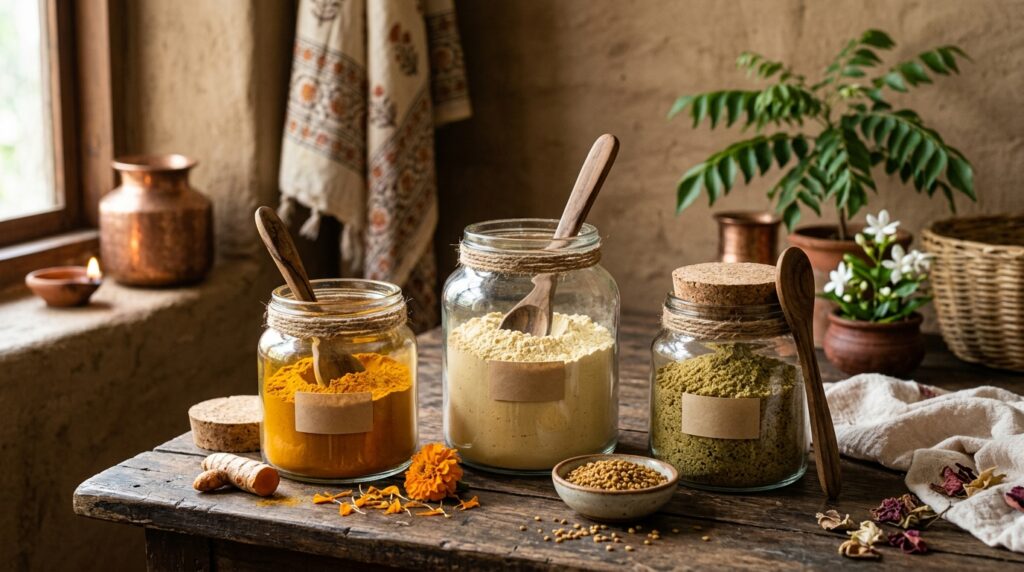
Instead, a herbal bath powder, called Snana Choorna, is used. This is a powder you can buy ready-made, or make at home with:
- 100 grams Kasturi turmeric (a wild turmeric variety traditionally used for skin, different from the cooking spice)
- 300 grams chickpea flour (besan)
- 100 grams fenugreek powder (menthya)
Mixed together, this becomes a gentle, natural cleansing powder used in place of commercial soap. In this tradition, soap and shampoo are generally avoided during the 21-day routine, as they are believed to work against the calming effect of the oil and herbal applications.
How to Use This Routine
Here is the daily sequence, start to finish:
- Prepare the Triphala kashaya fresh — boil 1 teaspoon of Triphala powder in 1 cup of water until reduced to half a cup, then strain.
- Apply the kashaya all over the skin using a cotton pad, and let it air-dry completely.
- Massage in Jatyadi oil once the kashaya has dried, covering the same areas.
- Leave the oil on for about one hour — this is not a rinse-off product, it needs time to sit.
- Bathe with cool or lukewarm water, using Snana Choorna (herbal bath powder) instead of soap or shampoo.
- Repeat daily for 21 consecutive days.
Traditional practitioners describe this routine as one that is followed consistently over 21 days, though individual experiences naturally vary. This is a traditional observation passed down through practice, not a clinically measured timeline.
Things to Keep in Mind
This routine is rooted in generations of household practice, but a few honest precautions matter here:
- Patch test first. Triphala, Jatyadi oil, and the bath powder ingredients are generally well tolerated, but everyone’s skin is different. Apply a small amount to your inner forearm and wait 24 hours before doing a full application.
- Kasturi turmeric can stain. It’s milder than cooking turmeric, but it can still leave a faint yellow tint on light fabrics or very fair skin temporarily.
- This is not a treatment for diagnosed skin conditions. If you have eczema, psoriasis, an autoimmune skin condition, or any diagnosed dermatological issue, please work with your dermatologist alongside or instead of this routine.
- Persistent or worsening symptoms need a doctor, not a home remedy. If your skin issue is painful, spreading, oozing, or accompanied by fever, see a healthcare provider promptly rather than waiting out the 21 days.
- Pregnant or breastfeeding readers should check with their doctor before trying any new topical herbal routine.
- Sourcing matters. Triphala powder, Jatyadi oil, and Kasturi turmeric are available through Ayurvedic suppliers and online retailers in the U.S. — look for reputable brands with clear ingredient sourcing.
When to See a Dermatologist
The transcript this routine is based on also mentions something important: when seasonal skin discomfort is persistent or these home approaches don’t bring relief, traditional Ayurvedic practice points toward Panchakarma — a more intensive, supervised cleansing therapy administered by a trained Ayurvedic practitioner, not something done at home.
People experiencing persistent symptoms should also consider consulting a dermatologist to rule out underlying conditions. Modern medicine and traditional practice are not in competition here — both have a role to play, and a dermatologist can identify things a home routine simply cannot.
A home ritual like the one above is a starting point, not a ceiling. If three weeks of consistent practice doesn’t bring the comfort you’re hoping for, that’s useful information — it may be time to consult either a licensed Ayurvedic practitioner or a dermatologist.
Frequently Asked Questions
Can I use this routine on my face? The Triphala kashaya and Snana Choorna bath powder are traditionally used on the face as well as the body in South Indian households, and are generally considered gentle. The Jatyadi oil step is typically used on the body rather than the face. As always, patch test on your jawline first, avoid the eye area, and stop use if you notice any irritation. Consult a dermatologist if you have sensitive or acne-prone facial skin before trying any new routine.
Is Triphala safe to put directly on the skin? Triphala has a long history of topical use in Ayurvedic tradition and is generally well tolerated. As with any new ingredient, patch test on a small area first, and stop use if you notice irritation.
Where can I buy Jatyadi oil in the United States? Jatyadi oil is available through Ayurvedic specialty retailers and online marketplaces. Look for brands that list their full ingredient sourcing and avoid products with added synthetic fragrance, since the point of this routine is to move away from heavily processed skin products.
Can I use regular turmeric instead of Kasturi turmeric in the bath powder? Regular cooking turmeric (Curcuma longa) is much stronger and will stain skin and fabric significantly more. Kasturi turmeric (Curcuma aromatica) is a different variety traditionally reserved for skin care specifically because it’s gentler and less staining.
What if my skin gets worse during the 21 days, not better? Stop the routine and consult a dermatologist. While this is traditionally considered a gentle practice, any worsening of symptoms is a signal that something else may be going on that needs medical attention.
Is this routine the same as a medical treatment for eczema or psoriasis? No. This is a traditional wellness practice, not a clinical treatment for any diagnosed skin condition. If you have a diagnosed dermatological condition, this routine should only be considered as a complementary practice alongside your dermatologist’s care — never as a replacement for it.
A Closing Thought
My grandmother never measured Pitta with a thermometer. She measured it by watching — who was scratching at their arm in the kitchen, who suddenly couldn’t tolerate the afternoon sun the way they could in February. Her response was never urgent or alarmed. It was the same quiet routine, repeated daily, trusting that consistency would do what panic never could.
If summer skin discomfort is wearing on you, there’s something worth borrowing from that approach — not a quick fix, but a steady, repeated ritual you give real time to work. And if three weeks pass and your skin still needs help, that’s not failure. That’s just information pointing you toward the next right step, whether that’s an Ayurvedic practitioner or a dermatologist.
If this was helpful, you might also want to read about other traditional approaches to seasonal wellness on AyurLoom.
Medical Disclaimer
The information in this article is based on traditional wellness knowledge passed down through generations in a Karnataka Brahmin household and is intended strictly for educational and informational purposes only. It does not constitute medical advice, nor is it intended to diagnose, treat, cure, or prevent any disease or medical condition. The statements in this article have not been evaluated by the U.S. Food and Drug Administration. Individual results vary significantly. Always consult a qualified, licensed healthcare professional — including a dermatologist for skin concerns — before making any changes to your health or skincare routine, especially if you are pregnant, nursing, taking medications, or managing a diagnosed skin or medical condition. The author is a traditional wellness knowledge carrier, not a licensed medical practitioner.
About the Author
Sanathani is an engineer by education and a traditional wellness knowledge carrier by birth, raised in a Karnataka Brahmin household where traditional remedies have been practiced and preserved for centuries. With access to thousands of authentic Kannada traditional wellness transcripts from practitioners and gurus, she translates knowledge that has never appeared in English before. Through AyurLoom, Sanathani carries this living wisdom into English for the very first time. “These remedies are not invented. They are remembered.” 🌿