

This traditional Ayurvedic sleep routine centers on timing and a calming wind-down sequence: a consistent bedtime, finishing dinner by 7 PM, avoiding screens after 6:30 PM, bathing before bed, and massaging warm coconut oil onto specific points on the body before sleep. This routine is traditionally practiced consistently for about a week, though experiences vary from person to person. It is not a substitute for medical care, and persistent or severe sleep problems should be evaluated by a doctor.
Table of Contents
- Why Timing Matters More Than You Think
- The 7-Day Evening Ritual, Step by Step
- How to Use This Routine
- Things to Keep in Mind
- When Lifestyle Changes Aren’t Enough
- Frequently Asked Questions
Why Timing Matters More Than You Think

My grandmother went to bed at the same time every single night of her life, long before anyone in our family had heard the word “circadian rhythm.” She didn’t need science to tell her that a body which sleeps and wakes at consistent times feels different from one that doesn’t. She just knew it, the way she knew most things — by living it for decades.
In Ayurveda — the traditional Indian system of wellness — there’s a concept called dinacharya, meaning daily routine. The idea is that aligning your habits with natural rhythms of light and darkness supports the body’s overall balance, including sleep.
This article focuses specifically on the evening side of that routine: a sequence of small, consistent habits practiced in the hours before bed, traditionally followed for about a week to help establish deeper, more restful sleep.
The 7-Day Evening Ritual, Step by Step
This routine is built around seven simple habits, practiced together and repeated nightly. None of them require special equipment — just consistency.
Step 1: Keep a Consistent Bedtime
Many Ayurvedic traditions recommend an earlier bedtime, often between 8 and 10 PM. However, the exact timing may vary from person to person. Consistency is traditionally considered just as important as total sleep duration.
Step 2: Put Screens Away After 6:30 PM
This routine recommends avoiding phone and TV screens after 6:30 in the evening. The reasoning given is that screen light close to bedtime interferes with the body’s natural wind-down process — a concept that lines up with what’s now widely understood about blue light and melatonin production, though the specific cutoff time reflects traditional practice rather than a clinically established threshold.
Step 3: Finish Dinner Before 7 PM
Eating dinner earlier in the evening — before 7 PM — is meant to give the body time to digest before lying down, rather than going to bed on a full stomach.
Step 4: Bathe Before Bed

A bath before sleeping is part of this wind-down sequence, traditionally believed to help signal to the body that the day is ending.
Step 5: A Warm Oil Massage Before Bed

This is the most detailed part of the ritual. Warm coconut oil is massaged onto several specific points on the body:
- Palms and soles of the feet — rubbed together in a way that naturally massages both at once
- Navel — a small amount of oil applied directly
- Scalp — about half a teaspoon, gently massaged in
- Behind the ears or temples — a small amount massaged gently
Step 6: Choose a Comfortable Sleeping Position
Some Indian households traditionally encourage sleeping on the left side. However, comfort and medical conditions vary, so follow the sleeping position recommended by your healthcare provider.
Step 7: Breathe Slowly and Settle Your Mind, or Practice Yoga Nidra
As you settle into position, this routine suggests slow, deep breathing paired with the quiet mental repetition of a calming phrase, prayer, mantra, or simply continued slow breathing — as a way to settle the mind. In some Indian households, phrases such as “Om Namah Shivaya” are traditionally used. Alternatively, the practice of yoga nidra, a guided relaxation technique sometimes described as “yogic sleep,” can be used in the same way.
How to Use This Routine
Here’s the sequence in order, as it would unfold across an evening:
- By 6:30 PM — put away phones and turn off the TV
- By 7:00 PM — finish dinner
- Before bed — take a bath
- Just before sleeping — massage warm coconut oil onto palms, soles, navel, scalp, and behind the ears or temples
- Get into bed — choose a comfortable sleeping position, following any guidance your doctor has given you
- As you fall asleep — breathe slowly and either repeat a calming phrase, prayer, or mantra quietly in your mind, or practice yoga nidra
- Repeat nightly for 7 consecutive days, aiming to be asleep between 8 and 10 PM each night
This routine is traditionally practiced consistently for about a week, though experiences vary from person to person — how quickly any shift toward deeper sleep happens, and whether it happens at all, depends on the individual.
Things to Keep in Mind

- This is a lifestyle routine, not a treatment for diagnosed sleep disorders. If you have been diagnosed with insomnia, sleep apnea, or another sleep disorder, this routine should be discussed with your doctor and used alongside — never instead of — your prescribed care.
- An 8 to 10 PM bedtime isn’t realistic for everyone. Work schedules, family responsibilities, and individual chronotypes vary. The consistency of your bedtime likely matters more than hitting this exact window — talk to a sleep specialist if you’re unsure what’s realistic for you.
- Patch test the oil. Coconut oil is generally well tolerated, but if you have sensitive skin, test a small area first.
- Sleeping position should follow your doctor’s guidance, especially if you are pregnant or managing a heart, shoulder, digestive, or sleep-related condition. What’s traditionally suggested isn’t necessarily what’s medically right for you.
- If sleeplessness is affecting your daily functioning, mood, or safety, don’t wait out a 7-day trial — see a doctor sooner.
When Lifestyle Changes Aren’t Enough
This routine is based on honest about something worth repeating here: for people whose sleep difficulties don’t resolve with lifestyle changes alone, some Ayurvedic practitioners may recommend therapies such as Shirodhara (a continuous stream of warm oil poured over the forehead) and Panchakarma (a broader supervised cleansing therapy), both of which require professional supervision and should never be attempted at home.
This is useful information rather than something to feel discouraged by. If a week of consistent evening routine doesn’t bring meaningful improvement, that’s a signal to loop in a professional — whether a licensed Ayurvedic practitioner for something like Shirodhara, or a physician or sleep specialist to rule out an underlying sleep disorder. Persistent insomnia can have many causes, some of which need medical evaluation rather than a home routine.
Frequently Asked Questions
Is it really necessary to go to bed by 8 or 10 PM? That specific window reflects traditional Ayurvedic teaching rather than a fixed clinical rule. What seems to matter most, including in modern sleep science, is consistency — going to bed and waking at roughly the same time each day. If 8 to 10 PM isn’t realistic for your life, aim for the earliest consistent bedtime that works for you.
Can I do the oil massage without doing the full 7-day routine? Yes — these steps don’t have to be all-or-nothing. Many people start with just the oil massage and screen cutoff, then add other steps gradually as they become habits.
What if coconut oil isn’t right for my skin? Some traditions suggest other oils, like sesame oil, as alternatives. If you have sensitive or acne-prone skin, you may want to use a smaller amount or consult a dermatologist about which oil suits your skin type.
Is sleeping on one side actually better for sleep quality? Some traditions suggest the right side, but this reflects traditional guidance rather than an established clinical finding. Comfort genuinely varies from person to person, and if you have a medical condition that affects which position is safe for you — including pregnancy, acid reflux, or sleep apnea — follow your doctor’s guidance over any general tradition.
Can I do only one or two steps instead of the entire routine? Yes. Many people begin with just an earlier dinner or the warm oil foot massage and gradually add other habits. Consistency matters more than perfection.
Can I do this routine if I work night shifts? Traditional Ayurvedic teachings generally emphasize consistency more than exact clock times. If you work nights, maintaining a regular sleep schedule may be more realistic than trying to match a specific bedtime window.
What if I follow this for a week and still can’t sleep well? That’s important information, not failure. Ongoing sleep difficulty after consistent lifestyle changes is a reasonable signal to talk to a doctor or sleep specialist, who can check for underlying causes that a home routine isn’t designed to address.
A Closing Thought
My grandmother used to say that sleep was the one medicine nobody had to pay for and almost everybody refused to take seriously. She wasn’t wrong about how undervalued it is — we treat a good night’s sleep as a luxury instead of a foundation.
This routine won’t fix every kind of sleep problem, and it isn’t meant to replace a doctor’s care if you need it. But if your evenings have become a blur of screens and late dinners and no real wind-down at all, there’s something worth trying in slowing all of that down — on purpose, at the same time, every night, for just a week.
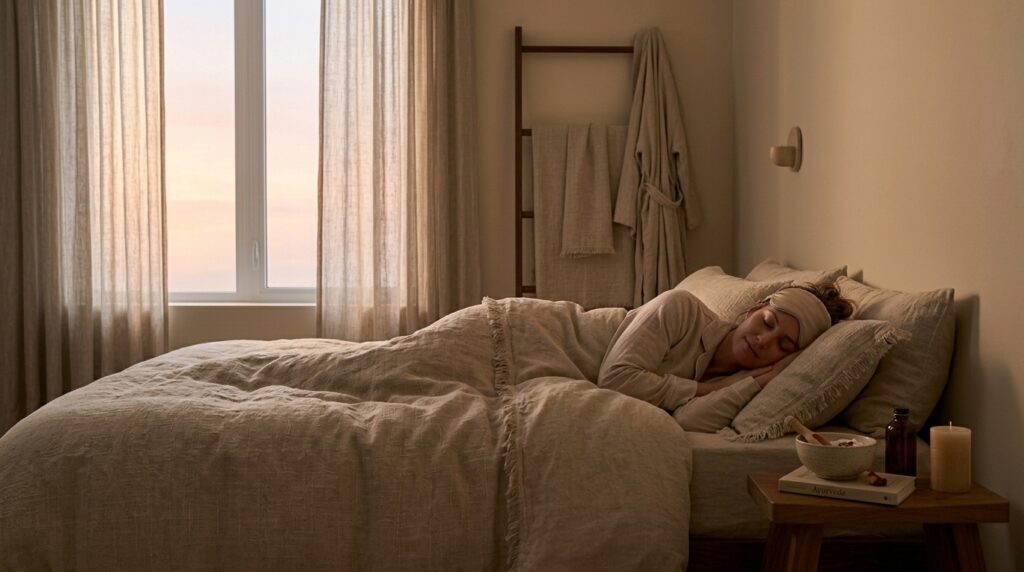
If this was helpful, you might also want to explore other traditional approaches to rest and wellness on AyurLoom.
Medical Disclaimer
The information in this article is based on traditional wellness knowledge passed down through generations in a Karnataka Brahmin household and is intended strictly for educational and informational purposes only. It does not constitute medical advice, nor is it intended to diagnose, treat, cure, or prevent any disease or medical condition, including insomnia or any other sleep disorder. The statements in this article have not been evaluated by the U.S. Food and Drug Administration. Individual results vary significantly. Always consult a qualified, licensed healthcare professional — including a physician or sleep specialist for ongoing sleep difficulties — before making changes to your health or sleep routine, especially if you are pregnant, nursing, or managing a diagnosed medical condition. The author is a traditional wellness knowledge carrier, not a licensed medical practitioner.
About the Author
Sanathani is an engineer by education, raised in a Karnataka Brahmin household where traditional wellness practices were passed from one generation to the next. She translates Kannada household knowledge for modern English readers. Through AyurLoom, Sanathani carries this living wisdom into English for the very first time. “These remedies are not invented. They are remembered.” 🌿