
Key Takeaway: There’s an old Kannada film lyric that goes, roughly, “milk and honey becoming one, that’s what our life is.” It’s romantic — but it’s also pointing at a real Ayurvedic debate. Some classical teachings list milk and honey together as an incompatible combination to avoid. Others describe a specific, careful way to combine them — raw honey, never heated, stirred into cooled milk — as a genuinely restorative morning tonic. This article lays out both sides honestly, plus the one rule almost everyone agrees on: honey should never touch anything hot.
A Question Bollywood Wouldn’t Touch, But a Kannada Song Did
There’s a scene that plays out in a lot of Ayurveda-curious households: someone reads that honey is good for you, someone else reads that milk is good for you, and somebody decides to just… put them together. Simple enough, right?
Except Ayurveda has actual opinions about this. Strong ones. And they don’t all agree with each other.
There’s a well-loved line from a Kannada film song — sung, memorably, by the actor and playback legend Dr. Rajkumar — that goes something like “just as milk and honey become one, so does your life and mine.” It’s a love song, technically. But it’s also quietly referencing something real: the idea that milk and honey, combined a certain way, were part of how earlier generations actually ate.
So which is it — tonic or taboo? The honest answer is: it depends on how you do it, and which classical source you’re reading. Let’s walk through what’s actually being said.
Table of Contents
- The Real Debate: Is Milk + Honey a “Viruddha Ahara”?
- The One Rule Almost No One Disputes: Never Heat Honey
- Why Honey and Milk Are Said to Balance Each Other
- What This Tonic Is Traditionally Used For
- How to Use Milk and Honey the Traditional Way
- Things to Keep in Mind
- Choosing the Right Milk
- FAQs
- A Closing Thought
The Real Debate: Is Milk + Honey a “Viruddha Ahara”?

Ayurveda has a whole category called viruddha ahara — literally, “contradictory” or “incompatible” food combinations. Foods that clash in some way, according to this framework, whether in taste, temperature, processing, or effect on the body. Fish and milk is the most commonly cited example. Honey and ghee in equal proportions is another.
Milk and honey together shows up in some traditional lists of incompatible combinations too — which is worth saying plainly, because a lot of wellness content skips over it. [needs source: exact classical textual citation for milk-honey specifically as viruddha, as opposed to honey-ghee, would strengthen this claim.]
At the same time, other traditional teachings — including the one behind this article — describe a specific, sanctioned way to combine milk with select ingredients, honey included, drawing on guidance traditionally attributed to Ayurvedic acharyas (teachers) on what may safely be added to milk. That list traditionally includes haritaki (a fruit used in classical formulations), black pepper, pippali (long pepper), turmeric, saindhava lavana (a type of rock salt), mango, and honey.
So which is right? Honestly — this is a genuine point of internal disagreement within Ayurvedic tradition, not a case where one source is “correct” and the other is making it up. The practical takeaway for a beginner: if you choose to try milk and honey together, do it the specific, careful way described below, in moderate amounts, and pay attention to how your own body responds. If you have a health condition or are on medication, it’s worth asking a doctor or Ayurvedic practitioner familiar with your history before making it a regular habit.
The One Rule Almost No One Disputes: Never Heat Honey

Here’s the part of this teaching that shows up across nearly every Ayurvedic source, regardless of where they land on the milk question: never add honey to anything hot.
Not hot milk. Not hot tea. Not hot water. Traditionally, heating honey is described as changing its fundamental nature — turning it from something beneficial into something the old texts describe, without much subtlety, as toxic (ama or a poison-like quality). Some modern discussions connect this to the idea that heat breaks down honey’s natural enzymes and can produce compounds considered harmful in excess. [needs source: the specific chemistry — such as HMF (hydroxymethylfurfural) formation in heated honey — is a real, documented process, but claims about its toxicity at typical kitchen-heating levels should be treated cautiously and verified against current food science.]
Practically, this means: if you’re making the milk-honey tonic described in this article, the milk needs to be boiled first, then fully cooled before you stir in the honey. Warm is too warm. This one rule is worth remembering even if you take nothing else from this article.
Why Honey and Milk Are Said to Balance Each Other
Ayurveda evaluates foods partly through rasa (taste) and virya (energetic potency, roughly “heating” or “cooling”). This is where honey tends to surprise people.
Most people assume honey is a “heating” food. Traditionally, though, honey is described as having a sweet primary taste (madhu rasa) with a secondary astringent quality (kashaya anurasa), a drying action (ruksha), and — this is the surprising part — a cooling potency (sheeta virya), not a heating one.
Milk, meanwhile, is traditionally described as unctuous (snigdha), sweet (madhura), and also cooling in potency.
Put together, the traditional logic goes like this:
- Honey’s drying quality is thought to help offset milk’s heaviness, which is traditionally associated with keeping kapha (the earth-and-water dosha, linked to heaviness and congestion) from building up.
- Both ingredients’ sweet taste is traditionally considered soothing to pitta (the fire dosha, linked to heat and inflammation).
- Milk’s unctuous, oily quality is traditionally thought to help calm vata (the air-and-space dosha, linked to dryness and instability).
Between the two of them, in other words, all three doshas are traditionally described as getting some attention — which is the basis for calling this combination a balancing tonic, when the incompatibility concerns above don’t apply to your situation.
What This Tonic Is Traditionally Used For
Traditionally, a glass of cooled milk with a spoon of raw honey — taken on an empty stomach in the morning — is described as working in two ways: as balya (strengthening to the body) and brumhana (nourishing, tissue-building). In practical terms, this combination has traditionally been associated with:
- Supporting digestion and easing occasional constipation
- Strengthening muscle tissue and supporting the nervous system — traditionally linked to reducing numbness, fatigue, and general weakness
- Supporting healthy weight and nourishment for those who are underweight or recovering strength
- Promoting skin radiance, both from the inside and through external use (see below)
- Supporting hair growth and eye health
- Soothing minor throat irritation
- Supporting heart health and easing occasional palpitations, anxiety, or restlessness
- Supporting lung strength and digestive capacity
- Supporting liver function and gut bacteria balance
- Supporting bone density, alongside muscle strength
- Supporting immune function, including in children
That’s a long list, and it’s worth pausing on. This is traditional Ayurvedic use — not a clinically proven treatment for any of these areas, and definitely not a substitute for medical care where any of them represent a real, diagnosed concern. Some traditional teachings additionally describe adding a small amount of turmeric to this milk-honey mixture as supportive during recovery from serious respiratory illness, including pneumonia or tuberculosis. This point deserves real caution: pneumonia and tuberculosis are serious medical conditions requiring proper diagnosis and treatment from a doctor. A milk-honey-turmeric tonic might traditionally be seen as a supportive, nourishing addition during recovery — never as a replacement for medical treatment.
There’s also a traditional external use worth mentioning: mixing about one to two teaspoons of honey into 100ml of milk and gently massaging it onto the skin before bathing, said to leave skin noticeably radiant. This is a cosmetic, topical use rather than an ingested one, and is generally considered low-risk for most people — though anyone with a known honey allergy should obviously avoid skin contact with it too.
How to Use Milk and Honey the Traditional Way

- Boil your milk, then let it cool completely. Room temperature or slightly warm to the touch — not hot.
- Stir in about one teaspoon of raw honey per glass (roughly 200-250ml of milk). Don’t overdo the quantity; this is meant to be a modest daily habit, not a large serving.
- Take it on an empty stomach, traditionally first thing in the morning.
- Optional addition: about half a teaspoon of turmeric powder, particularly during recovery from respiratory illness — with your doctor’s input if you’re actively unwell.
- For the skin version: mix one to two teaspoons of honey into 100ml of milk, massage onto skin, and rinse off in your bath.
Things to Keep in Mind
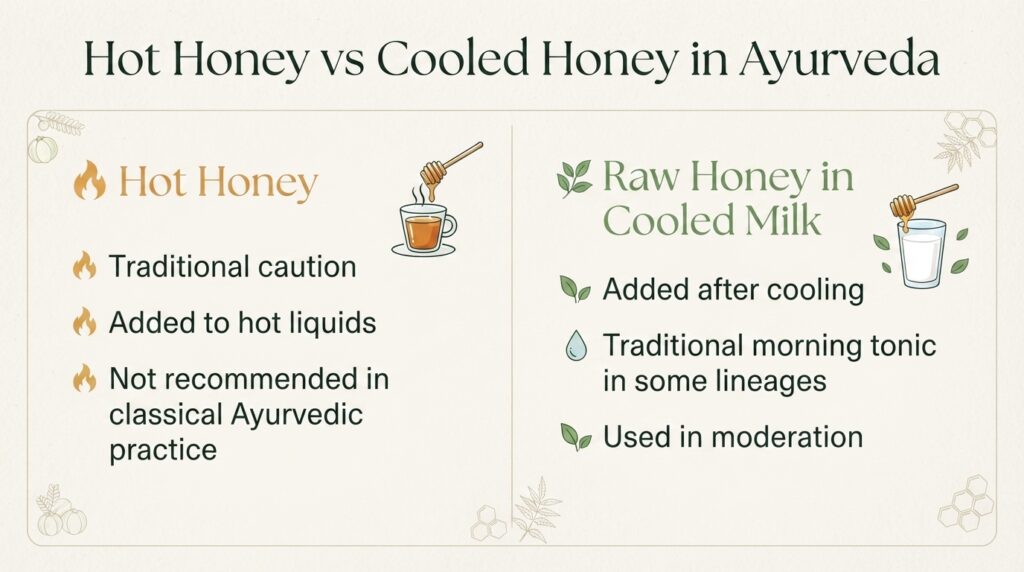
- Never mix honey into anything hot. This is the one non-negotiable across nearly all Ayurvedic teaching on honey.
- The milk-honey combination itself is debated within Ayurveda. Some classical sources list it as an incompatible combination; this article reflects a traditional counter-teaching that considers it safe and beneficial when prepared carefully. If you have digestive sensitivity, try a small amount first and notice how you feel.
- Infants under one year should never be given honey, due to a small but serious risk of infant botulism — this is a well-established modern medical guideline, not just an Ayurvedic one.
- If you have diabetes or are managing blood sugar, both milk and honey affect blood glucose, and this tonic should only be added to your routine with a doctor’s guidance.
- If you have a dairy sensitivity, lactose intolerance, or a honey allergy, this isn’t the tonic for you — there are other traditional options worth asking an Ayurvedic practitioner about instead.
- This is traditional use, not medical treatment, especially regarding the respiratory and heart-related benefits mentioned above.
Choosing the Right Milk
The transcript this article is based on makes a specific point about milk quality, and it’s worth passing along: traditionally, desi (native breed) cow’s milk is considered the gold standard, with goat’s and sheep’s milk also considered good options. Buffalo milk is traditionally considered suitable, especially for people doing physically demanding work. Milk from Jersey cows (a common commercial dairy breed) and standard packaged/pasteurized milk are traditionally considered less ideal, though they’re obviously far more accessible for most people today.
If native-breed or farm-fresh milk isn’t realistically available to you, using good quality pasteurized milk is a perfectly reasonable substitute — the broader point is simply that fresher, less processed milk is traditionally preferred where you have the choice.
FAQs
Is it actually safe to mix milk and honey?
Views differ even within Ayurvedic tradition. Some classical sources caution against the combination; others describe a specific method (raw honey, added to fully cooled milk, in modest quantity) as a beneficial daily tonic. If you want to try it, start small and pay attention to your own digestion.
Why is heating honey considered dangerous in Ayurveda?
Traditionally, heat is believed to change honey’s essential nature into something harmful. This lines up with the fact that heating honey does chemically alter it — though the specific health effects of that change at typical cooking temperatures need more direct research to confirm.
Can children have milk and honey?
Honey should never be given to infants under one year old, due to a recognized botulism risk. For older children, this is a family and pediatrician decision — this article isn’t a substitute for that guidance.
Does milk and honey help you gain weight?
Traditionally, this tonic is associated with brumhana (nourishing, tissue-building) effects, which some people use to support healthy weight gain. It’s not a guaranteed or medically proven method for weight change, and anyone with specific weight or nutrition goals should work with a doctor or dietitian.
What’s the best time to drink milk and honey?
Traditionally, it’s taken first thing in the morning, on an empty stomach.
Is honey really cooling, not heating, in Ayurveda?
Yes — this is one of the more counterintuitive points in Ayurvedic food science. Honey is traditionally classified as having a cooling potency (sheeta virya), despite the common assumption that it’s a “heating” food.
A Closing Thought

These remedies are not invented. They are remembered — and sometimes, they’re also debated, which is part of what makes this tradition feel alive rather than fixed. Milk and honey isn’t a simple yes-or-no answer in Ayurveda. It’s a genuine conversation that’s been happening for a long time, between different teachers and different texts. The most honest thing this article can offer is what’s actually being said, on both sides, so you can make an informed choice for yourself — the way an old family kitchen would, generation to generation, one careful spoonful at a time.